
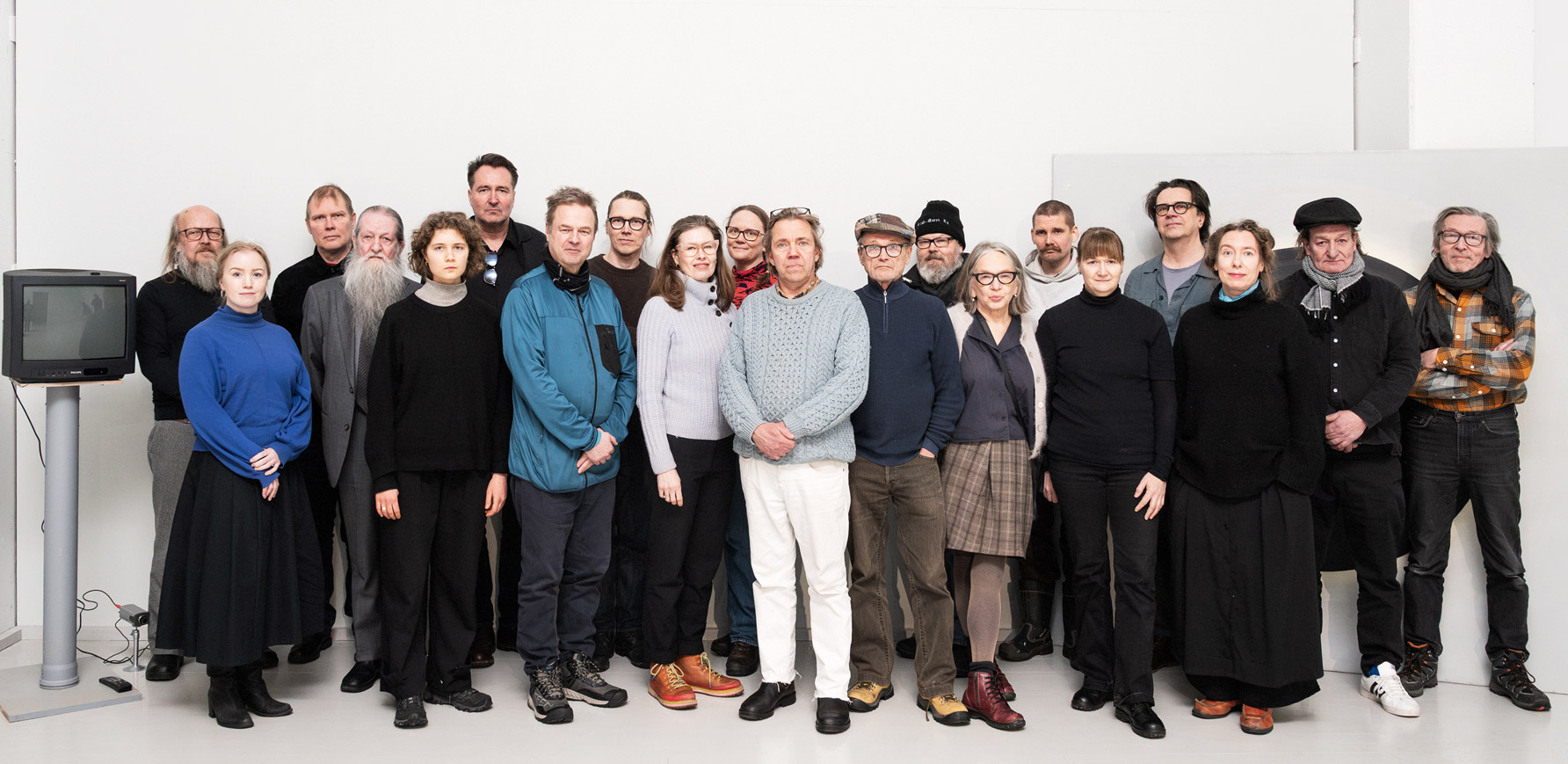
Over thirty artists have been invited to participate in the XXX Mänttä Art Festival exhibition titled On Being. The artists are united by their timelessness and minimalism, and by the fact that their works reflect on and explore existence and sensations from various dimensions. The Curator of the exhibition is Leena Kuumola. XXX Mänttä bildkonstveckorna konstnärspresentationer på svenska.
Stig Baumgartner
Stig Baumgartner’s paintings follow a consistent rule: each geometric composition contains an equal number of horizontal and vertical rectangles. Baumgartner explains, ‘This approach provides both a limited freedom and a way of structuring my observations, reflecting the ideals of harmony and order in Western painting. My works comment on the ideals of universalism in modernism and explore themes of control, rationality, and unseen social structures. However, I also view my geometric forms as a practical way of thinking, with playful and narrative elements.’ Transparent Identities, the title of Baumgartner’s work exhibited at the Mänttä Art Festival, nods to Josef Albers’ concept of colour relativity, in which colours are perceived in relation to their surroundings, and may therefore lose their identity. Transparency appears in Baumgartner’s works through vacant colour fields, translucent paint layers, and the use of birch plywood as a painting surface.
Kari Cavén
Kari Cavén is a Helsinki-based sculptor recognised for his innovative use of recycled materials. His materials are often recovered items from skips, construction sites, donations from collectors, and even mass-produced products. Some works are composed of multiple similar elements, while others feature unexpected combinations. Cavén’s sculptures are marked by inventive playfulness, and their often humorous titles carry significant meaning. He has presented numerous solo exhibitions in Finland and abroad, and has represented Finnish visual arts internationally, including twice at the Venice Biennale. His works are held by major art collections, and he has received honours such as the Pro Finlandia Medal and the Finnish Art Society’s Life Achievement Award.
Petri Eskelinen
Petri Eskelinen works across a broad range of sculpture. Sometimes his sculptures seek physical closeness with the viewer. At other times, they depict fragile, life-like movement on their own, electromechanically. Eskelinen is interested in how and why we interpret movement as alive or even conscious. How small of a movement is enough for this experience? His works are often based on an impossible scientific problem, to which he seeks a solution by taking a roundabout route. How can artificial gravity or the rotation of another planet be presented on video? And how can an artificial plant that twists into a knot also be made to unravel? What is it like to be in the middle of and part of a quantum mechanical phenomenon? In Eskelinen’s time-lapse video works, living plants strive to solve various challenges set for them, appearing very human-like at times. The moving sculptures, on the other hand, strive to incorporate randomness into their actions. Everything is guided by curiosity about the impossible. Eskelinen has been awarded the Ducat Prize and the Visual Artist Award by the Artists’ Association of Finland, amongst other recognitions. His works have been exhibited in numerous galleries and museum exhibitions, and he has created several public artworks. Eskelinen’s works are represented in many of Finland’s most significant art collections.
Forest Camp
Forest Camp is an art collective founded in 1998. The collective’s members are Juha van Ingen, Pasi Eerik Karjula, Antti Keitilä, Markku Kivinen, and Marko Vuokola. Their working approach centres on an open exchange of ideas, collective authorship, and partial improvisation. Concepts emerge through interaction, in which artistic conventions are examined, expanded, and deconstructed. Process, collaboration, and the desire to perceive the world openly — often through play, humour, and absurdity — anchor their practice. Forest Camp’s work navigates the material and immaterial. Their pieces may be interventions, objects, site-specific installations, or scenarios activated only in the viewer’s imagination. The collective’s projects frequently inhabit public spaces and everyday settings, integrating subtly into their surroundings. Forest Camp is recognised for its Kakutus interventions, where temporary environmental artworks made from simple sandcastles called ‘sand cakes’ appear in urban and coastal landscapes. Kakutus works have been presented at sites such as Hietaniemi Beach, Helsinki; Rokansaari Island, Lake Saimaa; Madrid; Acciaroli, Italy; and Mohni Island, Estonia. Forest Camp’s actions are rooted in viewing art as an open question: what unfolds when a piece is temporary, its authorship shared, and its meaning revealed only when encountered?
Georg Grotenfelt
Georg Grotenfelt is a Helsinki-based architect, filmmaker, and former professor of wood construction. Since 1995, he has produced documentary films, including works on Finnish building traditions. In addition, Grotenfelt has directed and produced over 10 biographical documentaries and films through his self-founded company, Nostalgia Films. These films offer thoughtful portraits of artists and other individuals who have forged their own paths. His video works have been exhibited both in Finland and abroad. As an architect, he is recognised for integrating traditional Finnish wood construction methods into contemporary architecture. The Mänttä Art Festival will exhibit one of Grotenfelt’s video works.
Hepa Halme
For more than 40 years, Hepa Halme has worked mainly as a diverse freelance musician. Since the late 1970s, he has explored new expressive dimensions as a sideline to his career. His involvement with the Finnish Broadcasting Company’s experimental studio, the Viitasaari Summer Academy, and the Jack Helen Brut and Homo $ performance groups has fostered his engagement with experimental and multidisciplinary concepts. Halme is especially drawn to projects with a literary focus. The most notable of these are his performances and publications with Hannu Salama and Saila Susiluoto. In recent years, site-specific projects have increasingly become more significant in his work.
Risto Heikinheimo (1955-2010)
The late artist Risto Heikinheimo (1955–2010) was a painter, performance artist, and art world influencer — as well as one of the most central and colourful figures in the art scene of his time. He graduated from the Fine Arts Academy of Finland, now known as the Academy of Fine Arts, in the late 1980s. In 1988, Heikinheimo was named Young Artist of the Year. He was also one of the founders of the interdisciplinary performance groups Jack Helen Brut and Helmut Pantzer, and in 1987, he co-founded MUU ry to promote new, unestablished art forms. In his painting, Heikinheimo focused on the interaction between light and colour. The key performances of the Jack Helen Brut group were visually rich and decorative stage works. The performances included tributes to different periods of global art history. The group also created visual interpretations of various philosophical and worldview perspectives through visual art, music, dance, and lighting. Known for his ‘bygone world’ fashion, Heikinheimo created connections between performance art and other fields of art. As a painter, he was particularly known for his colour circles. His paintings will be on show at the Mänttä Art Festival.
Marjatta Holma
Marjatta Holma has worked as a painter for over two decades. In recent years, she has created several monumental yet minimalist series. The atmosphere and architecture of each exhibition space guide her creative process. Holma views paintings as structures that quietly engage with their surroundings. In her process, conceptual thought and spontaneous expression create a dynamic tension which Holma resolves through painting. Her technique emphasises reduction, rather than addition, rendering visible the traces of washed-out colours. Seams and joints, as well as coarse and smooth textures, play an elevated role. Holma uses oil and tempera on linen and cotton fabrics, which serve as central elements by themselves. She believes that minimalist expression holds particular significance in an era saturated by constant stimuli.
Martti Jämsä
Martti Jämsä is an expert in analogue photography, known for his craftsmanship, black-and-white images, and use of shadow and light. He wants to manage every stage of the image-making process, personally printing, priming, and framing each photograph. Jämsä received his first camera as a confirmation gift and, over the course of a half-century, has built a career as a photographic artist, producing 20 books and 23 portfolios. Summer Vacation, his series at the Mänttä Art Festival, features selenium-toned gelatine silver prints made from Polaroid negatives captured at his family’s summer cottage in Haapamäki between 1995 and 2004. He also created a book from this material with words by Antti Nylén: ‘Endless motion, the ripples of water or the swaying of a branch; the interplay of matter and spirit, technology and grace; is that not what is most perfect in this life?’ (Translated by Kasper Salonen).
Marja Kanervo
Marja Kanervo is widely regarded as one of Finland’s leading artists in site-specific and installation art. She has received the State Prize for Visual Arts and the Pro Finlandia Medal, among other honours, and is recognised as a pioneer in her discipline. Central to her practice is the notion that art need not be permanent. Kanervo explores the traces of lived experience, frequently utilising everyday materials such as cardboard boxes, plastic bags, and glass. She often transforms exhibition spaces traditionally considered untouchable by removing surfaces and structures. Since the early 1980s, her works have been presented in numerous solo exhibitions in Finland and abroad and are held by several major Finnish art collections.
Shoji Kato
Shoji Kato’s art works are reflections of his contemplations and researches on the elusive but existential relationships that sustain our lives between the earth and heaven. He works with numerous mediums: paintings, sculptures, photographs, installations, situations, texts – sometimes voices, moving images and people. This range reflects Kato’s multi-scalar and multi-faceted approaches to the theme that he calls the 'location of subjectivity', which is not necessarily bounded to certain physical bodies and places. Instead of identifying where and who it is, Kato’s works inspire to look into the linkages between matters and agencies spread across the universe that are shaping and disintegrating it. Shoji Kato was born in Japan, lived in the U.S., and lives and works in Helsinki since 2005.
Philip von Knorring (1948-2016)
Philip von Knorring (1948–2016) became interested in art in the late 1960s. He was involved in founding the influential artist group Elonkorjaajat, which was among the first in Finland to promote conceptual and experimental art. His primary media were photography and experimental short films, and he was a pioneer of Finnish video art. One of his best-known works is Bevakat, a video installation inspired by Stonehenge and constructed from surveillance cameras and monitors. It was exhibited at Moderna Museet in Stockholm in 1977 and at other venues. Von Knorring embraced conceptual aesthetics, and the freedom and experimentalism of the underground and avant-garde movements were integral to his practice. His video installation will be featured at the Mänttä Art Festival.
Heta Kuchka
Heta Kuchka engages with photography, moving image, installation, and drawing. In recent years, she has expanded her practice to include stage productions in collaboration with music and dance professionals as well as various communities. As a theme, Kuchka is intrigued by shifts in human relationships and self-image over the course of a lifespan. Her Finnish and American heritage, a combination of two differing cultures, grants her a multifaceted perspective of the world. Her work is distinguished by a sense of presence, humanity, and warm humour, and often involves role play featuring herself and others. The work she is presenting at the Mänttä Art Festival has been created in collaboration with composer Minna Leinonen. In 2006, she was named Young Artist of the Year, and in 2014, she represented Finland with a solo exhibition at the FocusFinland pavilion at ARCOmadrid. Kuchka’s works are held by several prominent art collections.
Mikko Kuorinki
Mikko Kuorinki, originally from Rovaniemi and currently based in Espoo, works primarily in the visual arts — producing installations, exhibitions, and publications that feature objects and texts. A found object, space, sound, or text often serves as a starting point for his work. Kuorinki’s practice is characterised by a documentary approach; he grasps onto what is at hand, rendering the ordinary — seemingly insignificant — a mystery. In recent years, he has expanded his work to include sound and will present a sound-and-object installation at the Mänttä Art Festival. Alongside his solo practice, he is also a member of the Hello dust and Happy Magic Society artist collectives. Furthermore, his works have been exhibited in numerous solo exhibitions and are included in the collections of the Museum of Contemporary Art Kiasma and the Finnish State Art Collection.
Minna Leinonen
Minna Leinonen’s compositions often emerge from encounters with nature, literature, and cultural heritage. She considers beauty and friction complementary companions in music, essential for mirroring the restless world and the ways we move through it. Leinonen’s compositions have been performed by the Tampere Philharmonic Orchestra, Tapiola Sinfonietta, BBC Philharmonic, Finnish Radio Symphony Orchestra, and defunensemble. Her string quartet received the Teosto Prize in 2024, and her accordion concerto was awarded the Emma Prize for classical music in 2025. Leinonen earned her Doctor of Music degree in 2025 and serves as the artistic director of the Tampere Biennale, a contemporary music festival. Equality in interdisciplinary projects is especially important to her. A collaboration between Leinonen and Heta Kutcha will be exhibited at the Mänttä Art Festival.
Mikko Maasalo
Mikko Maasalo works with moving image, painting, and installation, among other media. He employs light, sound, paintings, objects, and the unique situations they generate. Beyond sound installations and independent pieces, he has composed soundtracks for experimental films and videos. Maasalo has exhibited in numerous exhibitions, performances, and events since 1991, both in Finland and abroad. His two works at the Mänttä Art Festival extend the tradition of romantic landscape depiction, with natural phenomena serving as catalysts for aesthetic experiences. In these pieces, Maasalo seeks to reveal the unseen.
Inka Nieminen
Inka Nieminen is a sculptor based in Helsinki and Hailuoto. She places importance on the origin and meanings of her materials. Nieminen’s sculptures address transformations in the sea and landscape, with their conceptual content informed by both the provenance and inherent properties of the natural materials selected. In her works, Nieminen strives to highlight multisensory observations, the rhythm of specific places, and their temporal evolution. For the Mänttä Art Festival, her primary material is stripped willow, which is similar to bone in both colour and scale. The forms in these works evoke the cyclical processes that sustain life.
Taneli Rautiainen
Taneli Rautiainen is a visual artist and sculptor based in Helsinki, recognised for his many significant public artworks. He employs a wide range of techniques from sculpture to light and sound. Rautiainen is noted for transforming everyday elements into unfamiliar forms, thereby altering perceptions of reality. Rather than blending into their surroundings, his works are intended to challenge them. Rautiainen’s artworks are included in several prominent art collections.
Seppo Renvall
Seppo Renvall, a media and photographic artist based in Helsinki, developed an early interest in moving images. While Renvall primarily produces films and videos, his oeuvre also encompasses photography, installations, and happenings. His extensive body of work is widely recognised as among the most significant in Finland. Renvall’s films are typically abstract and black-and-white, characterised by fragmented narrative structures that explore everyday phenomena, emotions, and the fragility of human life. He frequently collaborates with musicians, DJs, and sound professionals. Renvall’s works and performances have been presented in numerous exhibitions in Finland and at leading international venues for experimental film and visual arts, including the Anthology Film Archives in New York, the Venice Biennale, and the São Paulo Biennale.
Catarina Ryöppy
Catarina Ryöppy is a sculptor, photographer, and installation artist whose international career began in the early 1960s. After graduating as an artist in Switzerland, Ryöppy has worked in a wide variety of locations, including Morocco and Alaska, reflecting the international scope of her artistic themes. Alaska, in particular, features prominently in her work. Foreignness and outsiderness are central themes in Ryöppy’s art. She frequently examines the construction and fluidity of identity, as well as themes of inferiority and threat. During her travels, Ryöppy often seeks out local flea markets for their direct link to local cultures. The objects she collects serve both as materials for her works and as evidence of people’s fluctuating preferences. Ryöppy has received several honours for her artistic achievements, including the State Prize for the Visual Arts and the Pro Finlandia Medal, and her works are included in major art collections in Finland and abroad.
Pekka Sassi
Pekka Sassi is recognised as one of the most significant experimental film and media artists of his generation. In the 1990s, he was among the first artists in Finland to establish media art as a distinct art form. Sassi characterises the duality of his work as a balancing act between narration and abstraction. His creative process often involves collage, combining found materials with self-produced images and sounds. Sassi is regarded as an unconventional and diverse artist who manages all aspects of his productions, including scriptwriting, directing, filming, editing, and sound design. He has received the Finnish Art Society’s Ducat Prize and the Maire Gullichsen Prize, and his works are held in collections of the Museum of Contemporary Art Kiasma, the Helsinki Art Museum, and the Finnish State Art Collection.
Alli Savolainen
Visual artist Alli Savolainen works with film, video, photography, and painting. She has tackled themes such as time, the urban environment, and nature. Since 1986, she has participated in nearly 100 solo and group exhibitions, and her video works have been presented in over 300 exhibitions and art events, both internationally and in Finland. She received the Grand Prix at the Lahti AV Biennale with Seppo Renvall in 1997 and the Arts Council of Uusimaa’s Art Prize in 2003.
Päivi Sirén
Throughout her artistic career, painter Päivi Sirén has focused on colour, its spatial qualities, and luminosity. She is recognised as a master of subtle nuances. Sirén constructs her paintings from dozens of thin layers of colour, on which she draws delicate lines with coloured pencils, adding an additional dimension.
Emilia Tanner
Emilia Tanner is a visual artist based in Helsinki. She frequently uses paper as a primary material in her minimalist works, exploring themes of time, transience, and perception. Tanner approaches paper as a three-dimensional medium that can be moulded, eroded, and carved. Her methods include exposing paper to light, laser burning, and relief printing. These works embody the idea of their own destruction, transformation, and disappearance. The study of distance, repetition, and discovery is central to Tanner’s practice. In recent years, she has focused on installations and light. Her work has been exhibited both in Finland and abroad, and she has received several awards, including the Maire Gullichsen Prize and the Finnish Art Society’s Ducat Prize.
Göran Torrkulla
Göran Torrkulla is a philosopher, essayist, and visual artist based in Turku, whose artistic career began in the late 1980s. He characterises his approach as exploratory anticipation, in which art and philosophy intersect to reshape our common beliefs and reveal the diversity of life and the world. Torrkulla has translated philosophical texts from English to Swedish and published essays in Finland and Sweden. Together with Kate Larson and Babis Carabeidis, he co-authored the essay collection Stiglöshet: 3 essäer om uppmärkamhetens former (Förlaget Lejd, Stockholm, 2014). Torrkulla has taught philosophy for decades at Åbo Akademi University and has also taught aesthetics at several art schools in Finland.
Senja Vellonen
Painter Senja Vellonen is recognised as a master watercolourist. She also creates artist’s books — unique artworks made in the form of a book — which she describes as book-shaped colour poetry. Her works are often serial, with subjects frequently recurring in her artist’s books. Vellonen draws inspiration from the nightly streets of Paris and Venice, as well as the bare landscapes of Iceland. Through her art, she explores the ongoing dialogue between light and shadow and examines how subtle shifts can transform a painting’s mood. Over five years, Vellonen created a watercolour series depicting a deserted wooden villa in Northern Helsinki, whose century-long history is intertwined with its environment and the lives of its inhabitants. These works were exhibited last year in The Persistence of Memory at tm•gallery.
Marko Vuokola
Marko Vuokola is a Helsinki-based artist whose conceptually rigorous practice explores time, observation, and knowledge. He is interested in the properties of materials and has utilised photography, sound, light, drawing, video, and installation in his practice. Vuokola’s art examines and emphasises subtle yet irreversible changes in the world: the movement and transformation of matter and the passage of time. It is often impossible to capture these processes, as they generally unfold beyond the boundaries of physical artworks: before, after, and between. His works have been presented in numerous solo and group exhibitions in Finland and abroad. Vuokola is also a member of the OLO and Forest Camp artist collectives.
Sofia Vuorenmaa
Sofia Vuorenmaa primarily works in printmaking, analogue photography, and text-based practices. Her work centres on observation, especially the sensitive, focused gaze, and on the relationship between sensory experience and language. The sea and the sky, with all their natural phenomena, are among her most important starting points. Her works often employ gestures that, with all their precision, attempt to vaguely depict what lies beyond the defining look. Vuorenmaa is currently finishing a Master’s in Fine Arts degree at the Academy of Fine Arts, University of the Arts Helsinki. She has participated in group exhibitions and residencies in Finland, Germany, and Lithuania.
Denise Ziegler
Denise Ziegler is a Swiss-born visual artist and researcher of public space based in Helsinki. Generally, her practice revolves around spatial installations and sculptures, but can also include drawing, painting, video, and literary-visual works. Ziegler frequently works site-specifically in and with public spaces. Her works are traces of gestures, of human activity, of something that has occurred. She reconstructs events that refer to inconspicuous human activity or everyday things, such as home plants, garden fences, or house numbers, and transplants them into a new context. This endows Ziegler’s works with not only poetic but also conflicting, sometimes even comical or tautological features. Ziegler is a senior university lecturer in the Transdisciplinary Art Studies unit at Aalto University.
Charlotta Östlund
Charlotta Östlund is a Swedish-born visual artist who lives and works in Helsinki. She creates sculptures through a time-consuming process that serves as a platform for her own existential reflection. As a result, her practice revolves around fundamental questions about our existence. In recent years, her process has stemmed from the idea of constant change of matter and existence. Working with fragile plant parts makes these processes of change tangibly present. By observing the vegetation around us, we see construction and decay. These processes build bodies and environments, and similar, more abstract movements shape our minds. The transformation of matter and energy can be seen as analogous to the constant change of thoughts, feelings, and experiences through which our identities are constructed.